

In Upper Assam, travelling long distances often means spending many hours on the road. Train routes are limited and road travel can be affected by weather and river crossings. Because of this Lilabari Airport plays a practical role for North Lakhimpur and nearby districts.
For the town of North Lakhimpur, this airport provides the nearest access to air travel. Without it most passengers would need to travel to larger airports such as those in Guwahati or Dibrugarh before boarding a flight. This increases travel time and cost.
The airport is mainly used by local residents, government officers, medical travellers defence defence-related movement and people travelling for work. In a region where geography limits fast transport small regional airports remain necessary rather than optional.
This article explains the airport in detail, including its location layout, facilities, operations and travel access.
In its early years, the airstrip at Lilabari was developed to support administrative and security movement in northern Assam. Operations were limited and there was no permanent passenger terminal.
With the introduction of regional civil aviation services, the airport slowly began handling scheduled passenger flights. Basic terminal facilities were added to manage check-in, security and boarding.
Development happened in small stages rather than large expansion phases. Over time, the airport shifted from a simple airstrip into a functional regional airport that supports regular civilian operations.
From a location point of view, the airport is situated around 8 kilometres from North Lakhimpur town. Road access is direct and travel time usually remains short under normal conditions.
The airport sits at an elevation of approximately 100 metres above mean sea level. Surrounding terrain is mostly flat which supports basic flight operations.
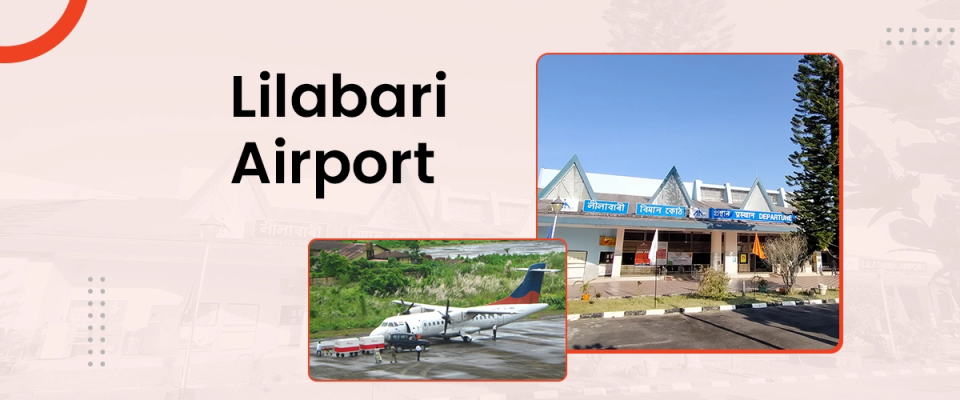
In physical layout, the airport has:
There is no parallel runway or large-scale airside area. The overall layout is designed only for regional traffic volumes.
At the core of airport operations is a single runway with a length of about 2,286 metres. The runway surface is paved and suitable for turboprop aircraft.
Because of runway strength and length, the airport mainly supports aircraft such as:
Large jet aircraft cannot operate here.
Taxiway facilities are basic and apron space allows parking for a limited number of aircraft at a time. Navigation aids are minimal which means operations depend heavily on visibility and daylight.
During fog, heavy rain or low cloud cover, flight delays or cancellations may occur.
The passenger terminal is compact and handles a limited number of passengers at a time. Seating capacity is generally designed for around 150 to 200 passengers during peak movement.
Facilities available inside the terminal include:
There are no lounges and retail options are minimal. Food choices are limited. The terminal focuses on basic passenger movement rather than extended comfort.
Accessibility support is basic and assistance is usually available on request.
Scheduled domestic flights operate from the airport under regional connectivity services. Aircraft used are turboprop models suitable for short runways.
Direct routes usually connect Lilabari with nearby regional hubs. From these hubs passengers can continue onward travel to other cities through connecting flights.
Flight frequency can vary depending on season demand and airline scheduling. Services are limited and not high frequency.
At present, the airport handles a moderate number of passengers and flight movements. Operations remain within existing infrastructure limits.
Key operational constraints include:
Future plans focus on gradual improvement rather than major expansion. Proposed developments include terminal upgrades and better passenger handling facilities.
Any expansion is expected to remain regional in scale.
From North Lakhimpur town, the airport can be reached by road in around 15 to 20 minutes under normal traffic conditions.
Common transport options include:
Public transport options are limited.
During monsoon months, additional travel time should be planned due to road conditions. Passengers are advised to arrive early because check-in and security facilities are limited in size.
In practical use Lilabari Airport serves as a small regional airport that supports basic air connectivity for North Lakhimpur and parts of Upper Assam. With a single runway limited facilities and turboprop operations the airport functions within clear limits while meeting everyday travel needs for the region.
Because flight options are limited careful booking and ticket management become important. Services such as Flightmojo support this by offering booking assistance airline partnerships and round the clock customer support.
Overall the airport remains a functional access point where planning and clear information make travel smoother.
1. What are the airport codes for Lilabari Airport?
Lilabari Airport has the IATA code IXI and the ICAO code VELB. These codes are used for flight booking ticketing and air traffic operations.
2. Which major cities are connected to Lilabari Airport?
Scheduled flights mainly connect the airport to Guwahati. From Guwahati passengers can take onward connections to other major cities across India.
3. Which airlines operate flights from Lilabari Airport?
The primary airline operating scheduled domestic flights from the airport is IndiGo. Services are operated using turboprop aircraft suitable for regional routes.
4. Does the airport have parking facilities?
Yes, there is a small parking area available near the terminal. It is suitable for private vehicles but space is limited during peak flight timings.
5. Are food and shopping options available at the airport?
Food and retail options are very limited. Passengers should not expect full-scale food courts or shopping outlets.













 Flights & Travel Guide&media=https://crm.flightsmojo.in//UploadedImages/d5fd7442-0549-4ff5-887a-678327a2811c.webp)

