

The story of aviation in Gwalior began as a military requirement rather than a civilian convenience. During World War II as the British administration identified Gwalior as a suitable location for air operations due to its open terrain and central positioning in the country but in 1942, the Royal Air Force constructed an airfield at Gwalior which was used as a pilot training base and as a staging point during war-time operations. This airfield laid the foundation for all future aviation activity in the region and built Gwalior as a permanent aviation location.
As the war ended and India moved toward independence then the airfield did not lose its importance instead it expanded its role under national control.
After India became independent then the control of the airfield was transferred to the Indian Air Force and the Government of India allowed the airbase to continue operating due to its strategic value and central location.
Over the years, the base evolved into one of the most significant Air Force stations in the country. The establishment of the Tactics and Air Combat Development Establishment further strengthened Gwalior’s position as a centre for advanced aerial combat training. The base became closely associated with fighter aircraft operations and remained an active defence installation.
While military operations continued to grow this airfield also began showing potential for civilian movement which gradually opened the path for civil aviation.
Civil aviation activity in Gwalior predates many modern regional airports. And in 1937, JRD Tata operated one of the earliest airmail flights in India which included Gwalior as part of the route connecting to Bombay.
This flight demonstrated that the airfield could support non-military operations as well. The Government of India recognised this potential and formally opened the airport for civil aviation in 1958. The first scheduled commercial passenger service was operated by Indian Airlines using DC-3 aircraft from Delhi.
As civil travel demand increased over time as it became necessary to define a structured system where both defence and public aviation could function together.
To support both military and civilian requirements a dual-use model was adopted for the airport. The Indian Air Force retained control of the main airbase while the Airports Authority of India was assigned responsibility for civil aviation operations. This arrangement allowed civilian passenger flights to operate through a dedicated civil enclave without interfering with defence activities. Gradual infrastructure upgrades followed to support this structure and to handle increasing passenger movement.
This dual governance directly shaped the airport’s present identity and role.
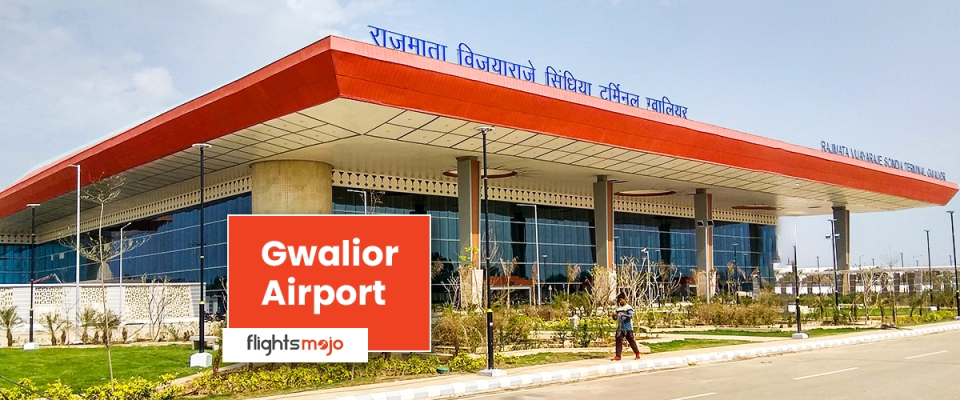
Today this airport is officially known as Rajmata Vijaya Raje Scindia Air Terminal and is commonly referred to as Gwalior Airport and it is classified as a domestic airport with a civil enclave and operates under the Airports Authority of India(AAI) for civil services while continuing to share its premises with the Indian Air Force(IAF). The airport is named after Rajmata Vijaya Raje Scindia who was the former Maharani of the Gwalior State and a prominent national political leader.
Gwalior Airport now functions as one of the major aviation gateways of Madhya Pradesh and supports tourism, education and employment-related travel. Its historical military roots and structured civil integration together define the airport’s significance in the regional aviation network.
Gwalior Airport is located in the Maharajpura area on the north-east side of Gwalior city in Madhya Pradesh. The Gwalior airport lies at an approximate distance of 10 km from the city center which keeps it accessible while avoiding dense urban congestion. Apart from the airport, Gwalior railway station is situated around 10 km away while the central bus stand is approximately 9 km from the airport.
The airport covers a total land area ranging between 760 and 760.7 acres which makes it one of the largest airports in Madhya Pradesh by physical scale. The civil enclave occupies about twenty-nine acres within the larger defence-controlled area. The airport stands at an elevation of 188 meters above mean sea level which is equivalent to 617 feet. The recorded coordinates are 26°17′36″N, 78°13′40″E.
Surrounding localities include Maharajpur, Airport Road, Deen Dayal Nagar which have seen steady development due to airport.
Gwalior Airport holds a rare operational advantage due to its dual runway configuration. It is the only airport in India where a civil terminal operates alongside two fully operational parallel runways. These runways are designated as 06L and 24R for one strip and 06R and 24L for the second strip.
Each runway measures 2743 meters in length which allows capable in the handling of narrow-body aircraft with the presence of 2 runways enables continuous air operations and reduces congestion while improving coordination between military and civilian movements. The apron and taxiway network supports parking for up to thirteen narrow-body or small aircraft and ensures smooth aircraft movement across the airfield.
This airside capability directly supports higher passenger throughput and future network expansion.
Gwalior Airport earlier operated with a single passenger terminal that handled approximately 250 to 350 passengers/hour. To meet the rising demand, a new passenger terminal was constructed with a total built-up area of around 200 sq meters which equals220,000 sq ft The new terminal increased peak-hour capacity to nearly 1400 passengers which is almost three times the earlier capacity.
The terminal was completed within 16 months and includes supporting infrastructure such as city-side development and organised car parking. Sustainability features include rainwater harvesting systems and a 2.5 megawatt solar power plant which supports reduced carbon dependency and long-term efficiency.
The terminal is designed to support future growth and planned international connectivity with a focus on Southeast Asian destinations.
Gwalior Airport is served by multiple domestic airlines are
Direct flights connect Gwalior with Delhi and Mumbai and Bengaluru and Ahmedabad and Hyderabad and Indore and Ayodhya. This network links the city with major economic and administrative centres across India.
The presence of multiple airlines results in competitive pricing which benefits travellers searching for Cheap Flight Tickets and Cheap Air Tickets. Passengers can Book Flights Online with flexible schedules and access to the Best Flights through reliable Flight Booking and Air Ticket Booking options. Gwalior Airport plays a role in reducing pressure on larger airports while offering convenient Flight to Gwalior options for business and leisure travellers.
The passenger terminal at Gwalior Airport provides structured movement and essential services. Facilities include spacious waiting lounges and modern check-in counters and retail outlets and souvenir shops. Cafes and snack bars operate within the terminal along with ATMs and cash facilities. Limited-duration free Wi-Fi is available for passengers.
Medical assistance and wheelchair support are provided while free baggage trolleys are available across the terminal. Lost and Found services are managed by airport authorities and a tourist information desk assists visitors. Senior citizens receive guided assistance during peak hours. Security screening is managed by CISF using modern equipment.
Ground connectivity from Gwalior Airport is primarily road-based. Taxis and auto-rickshaws and private vehicles operate regularly while app-based cab services such as Uber and Ola are widely available. Government buses connect the airport with key city locations. Gwalior Junction railway station lies approximately ten kilometres away.
Several hotels operate within short driving distance such as
.Accommodation options range from budget friendly to premium categories.
Airport upgrades have led to increased real estate activity. Airport Road records residential pricing between twenty and forty lakh rupees while Maharajpur sees prices above fifty lakh rupees. Deen Dayal Nagar reflects a broader range between 20 and 26 lakh rupees which indicates rising investor interest.
For official contact,
1. What is the official name of Gwalior Airport?
The airport is officially called Rajmata Vijaya Raje Scindia Air Terminal and serves as a domestic airport with a civil enclave.
2. What is the IATA and ICAO code for Gwalior Airport?
The IATA code is GWL and the ICAO code is VIGR.
3. Are parking facilities available at Gwalior Airport?
Yes, Gwalior Airport offers organized car parking near the terminal for both short-term and long-term use.
4. Where is Gwalior Airport located?
It is located in the Maharajpura area, north-east of Gwalior city, approximately 10 km from the city centre, 10 km from Gwalior railway station, and 9 km from the central bus stand.
5. Which airlines operate at Gwalior Airport?
The main airlines are IndiGo, Air India Express, Akasa Air, Alliance Air, and SpiceJet.
6. Which destinations are currently served from Gwalior Airport?
Direct flights connect Delhi, Mumbai, Bengaluru, Ahmedabad, Hyderabad, Indore, and Ayodhya.
7. How many runways does Gwalior Airport have?
Gwalior Airport has two parallel runways, each 2,743 metres long, allowing efficient handling of narrow-body aircraft and smooth coordination between civil and military operations.
8. What is the passenger terminal like?
The new passenger terminal can handle up to 1,400 passengers per hour, three times more than the old terminal, and includes modern check-in counters, lounges, retail outlets, cafes, ATMs, and tourist information desks.
9. What facilities are available for passengers?
Passengers have access to waiting lounges, Wi-Fi, baggage trolleys, medical assistance, wheelchair support, security screening by CISF, and lost-and-found services.
10. How is ground transportation from Gwalior Airport?
Connectivity includes taxis, app-based cabs (Ola/Uber), private vehicles, and government buses linking the airport with key city locations.







 – Complete Flight Information & Travel Guide&media=https://crm.flightsmojo.in//UploadedImages/e323e002-4258-408a-a67a-7de5a03433d7.webp)