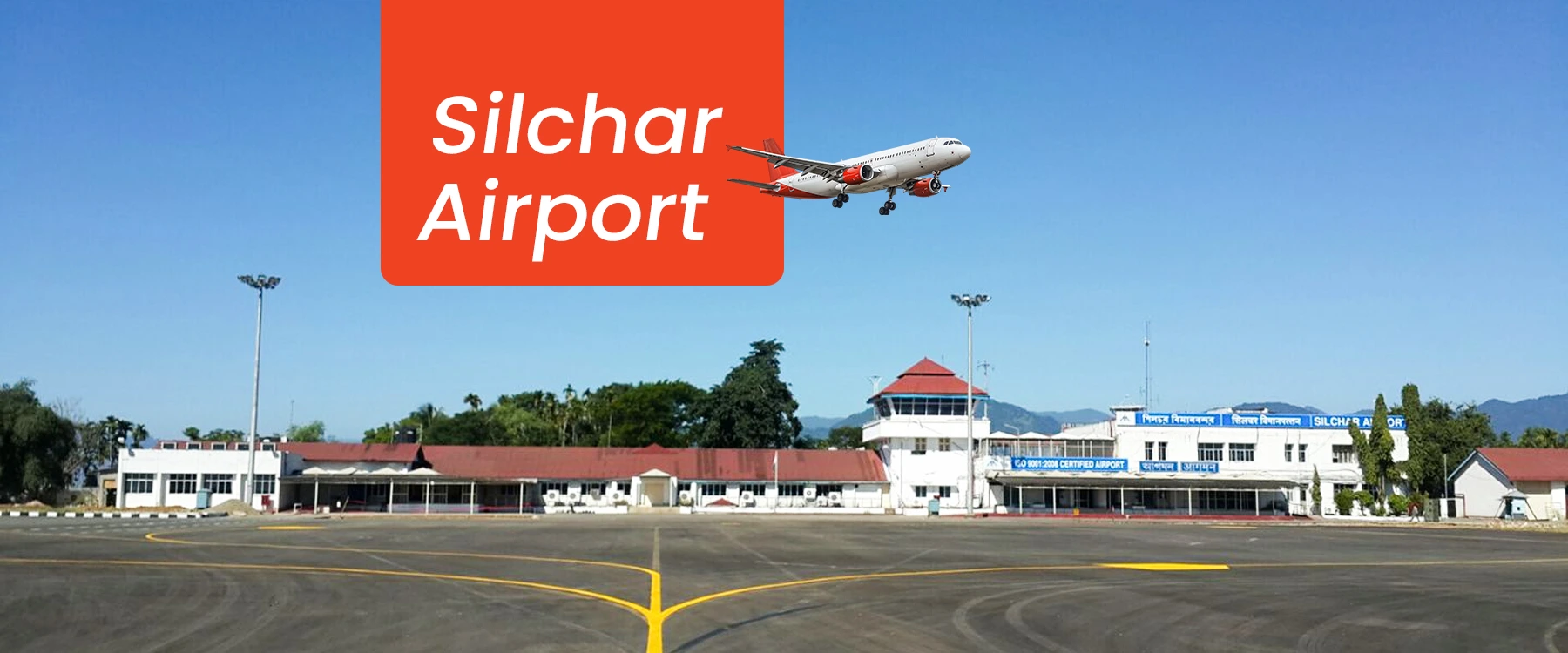

When you travel to southern Assam, the main gateway you will use is Silchar Airport, also known as Kumbhirgram Airport. This airport carries both history and modern importance. It was built in 1944 during British rule as RAF Station Kumbhirgram. Today, it serves as a domestic airport for Silchar and nearby districts while still operating as a civil enclave under the Indian Air Force.
Because the airport has grown steadily over the years, it now stands as one of the most important aviation hubs in North-East India.
Silchar Airport is located in Kumbhirgram, Assam 788031, India. It lies on the foothills of the Barail mountain ranges which gives the airport a scenic natural backdrop. Booking flight to Silchar is now simple with flightsmojo while the Silchar airport is approximately 29 kilometres from Silchar city centre, although the distance may vary slightly depending on the road route taken.
Important geographical and administrative details include:
Since the airport functions as a civil enclave, its daily operations follow strict guidelines set by the Airports Authority of India which ensures safety and efficiency.
Silchar Airport has a history that dates back to World War II. It was constructed in 1944 by the British and served as a military base known as RAF Kumbhirgram. During February and March 1943, No. 31 and No. 194 Squadrons of the Royal Air Force operated from here. Later, the 4th Combat Cargo Group of the United States Army Air Forces also used the airport between December 1944 and January 1945.
After India’s independence, the airport was transferred to the Royal Indian Air Force and later became a joint civil-military facility. Over time, it transformed from a wartime base into a vital regional airport serving the Barak Valley.
Because of this transformation, Silchar Airport today represents both historical importance and modern regional connectivity.
The airport operates with a single asphalt runway numbered 06/24. This runway measures 7,500 feet (2,286 metres) in length. It is capable of handling aircraft such as the Boeing 737 and Airbus A320 which are commonly used for domestic commercial operations.
The airport also includes important navigational systems:
These systems ensure that flight operations remain safe and reliable, especially during challenging weather conditions.
Silchar Airport has one domestic terminal. The airport covers 36.70 acres while the terminal building itself spans approximately 2,586 square metres.
The terminal is designed to handle 300 passengers at a time which is divided equally between arrival and departure sections. It includes:
Because of this structured layout, the terminal supports steady passenger movement without overcrowding.
Silchar Airport is currently the fourth busiest airport in North-East India, after Guwahati, Agartala and Imphal. Its passenger growth reflects increasing demand in the region.
Traffic statistics show steady expansion:
During the same 2024–25 period:
National rankings based on recent data place Silchar Airport as:
These numbers show that the airport plays a crucial role in connecting southern Assam to major Indian cities.
Several airlines operate from Silchar Airport. Current active routes include:
In addition, past and mentioned operators include Air India, Jet Airways and Air India Regional. Approximately 32 flights per week connect Silchar with major cities such as Imphal, Guwahati, Kolkata and Agartala.
There have also been announcements of services such as Mumbai to Silchar via Kolkata which further expand connectivity options.
Because of these regular services, Silchar remains well connected within the North-East and to metro cities.
Silchar Airport provides several facilities to ensure passenger comfort.
Baggage and assistance services include:
Eating and shopping options include:
Aviation fuel services at the airport are managed by Indian Oil which supports operational efficiency.
Because of these amenities, passengers experience a balanced mix of convenience and local cultural flavour.
Reaching the airport is convenient through multiple transport options.
By Road:
By Rail:
This strong ground connectivity supports smooth passenger movement to and from the airport.
Silchar is known for its green landscapes and cultural heritage linked to the Dimasa Kingdom. Visitors arriving at the airport can explore attractions such as:
Because the airport connects these locations to the rest of India, it supports tourism growth in southern Assam.
Silchar Airport has travelled a long journey from a wartime RAF base in 1944 to a modern regional airport serving nearly half a million passengers annually. With its structured terminal, navigational systems, growing passenger numbers and expanding connectivity, it continues to strengthen southern Assam’s link with major Indian cities.
While it retains its historical roots, it also demonstrates steady operational growth under the supervision of the Airports Authority of India and the Indian Air Force. Therefore, Silchar Airport stands today as a balanced blend of legacy, infrastructure and regional development.
1. What is the official name of Silchar Airport?
Silchar Airport is officially known as Kumbhirgram Airport. Its IATA code is IXS and its ICAO code is VEKU.
2. Where is Silchar Airport located?
The airport is located in Kumbhirgram, Assam 788031. It lies about 29 kilometres from Silchar city centre near the foothills of the Barail mountain ranges.
3. Who owns and operates Silchar Airport?
The Indian Air Force owns the airport. It operates as a civil enclave under joint management of the Indian Air Force and the Airports Authority of India.
4. When was Silchar Airport built and what was its original purpose?
The airport was built in 1944 during British rule as RAF Station Kumbhirgram. It served as a military airbase during World War II before becoming a joint civil-military airport after independence.
5. What are the runway specifications at Silchar Airport?
The airport has a single asphalt runway numbered 06/24. It measures 7,500 feet or 2,286 metres in length and can handle aircraft such as Boeing 737 and Airbus A320.
6. What navigational systems are available at the airport?
The airport is equipped with Precision Approach Path Indicators on both sides of the runway, an Instrument Landing System and a glide slope station. These systems support safe landings, especially in poor weather.
7. How many passengers can the terminal handle at one time?
The terminal can handle 300 passengers at a time. It includes 5 check-in counters, 2 security counters, 4 boarding gates and 2 baggage conveyor belts.
8. Which airlines operate from Silchar Airport?
Alliance Air and IndiGo operate regular flights. These airlines connect Silchar to cities such as Aizawl, Imphal, Kolkata, Agartala and Guwahati.
9. How busy is Silchar Airport compared to other airports in North-East India?
Silchar Airport is the fourth busiest airport in North-East India after Guwahati, Agartala and Imphal. It handled over 483,000 passengers between April 2024 and March 2025.
10. What passenger facilities are available at Silchar Airport?
The airport offers free luggage trolleys, wheelchair assistance, restaurants, snack counters, souvenir shops, ATMs and free WiFi. It also provides transport links through buses and taxis to nearby districts.